
How to Search Dixon County Criminal Dockets
The Nebraska Judicial Branch Case Information eServices page is the place to start. Pick the JUSTICE route. It covers county- and district-court trial cases statewide, Dixon County included. Have the defendant's full name ready. Bring any middle initial. Know the rough filing year, and the court named on a citation, complaint, or notice. A known case number is the sharpest search key you can bring.
Check Dixon County Court first for traffic, misdemeanor, municipal-ordinance, and preliminary-hearing matters. After bind-over, a felony may move to Dixon District Court. The official party-name route charges a one-time fee. So remember that an empty result screen never proves no court record exists.
- Open the official JUSTICE case-information path and choose the party-name or case-number option.
- Enter the party name exactly as known, including a middle initial when available; search a party rather than a witness.
- Use Dixon County, court type, year, or case type only to narrow a common name.
- Open the matching case and compare its court, parties, case type, and filing information before reading the register of actions.
- Check the calendar or the clerk for a current setting, and ask the court clerk about a certified copy when an official copy is needed.
JUSTICE Routes for Dixon Criminal Docket Research
JUSTICE is the statewide trial-court system, not a Dixon-only vendor portal. The one-time party-name search costs $17. It can return up to 30 public cases, and the window stays open for three calendar days. Two warnings come with it. A newly entered case may take about 24 hours to appear. A no-result search can still be charged. When a name might pull many matches, use a case number instead.
Heavy users can buy a Nebraska.gov subscriber account for $100 annually. It allows free general list searches, with $2 to view a record detail. The direct case-number and judgment-date paths also cost $2. For current or future settings there is the separate Multi-Court Case Calendar. It is no substitute for the criminal register.
The Judicial Branch publishes general-search criteria. Those are party name, court type, case type or subtype, county, year, judge, and attorney. A shared name alone is not a match. Confirm the Dixon County court. Check the filing information and the party role too before calling a result the right case. And treat a calendar entry cautiously on resets, since its own notice says timing and coverage can be incomplete.
What a Criminal Docket Shows
A Dixon criminal register can display plenty when the fields are public and available. Expect a case summary, filing date, court type, county, case type or subtype, parties, attorney listings, offense information, hearing entries, orders, financial information, and an outcome. The exact live label controls. A charge description by itself is not a disposition.
The official spells out which types of court information may be publicly accessible.
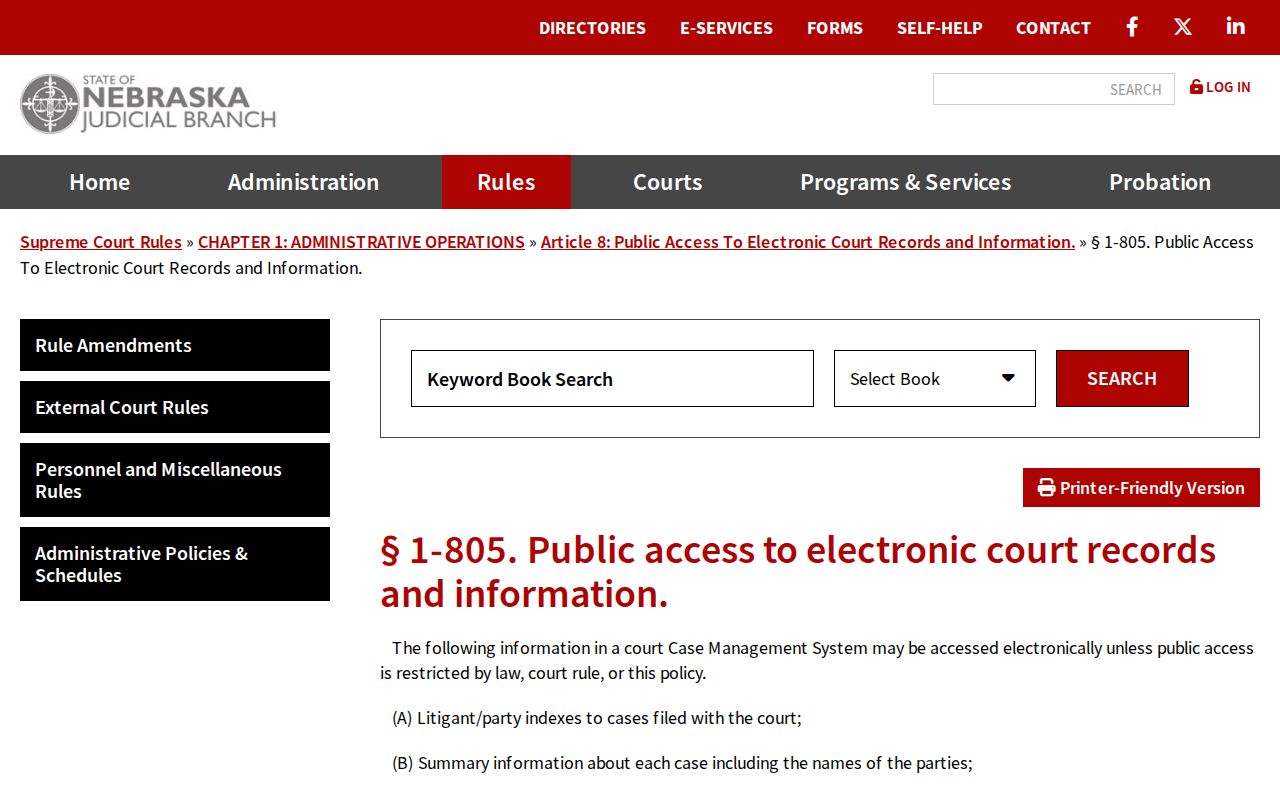
That rule explains why a Dixon County criminal register, calendar, or eligible image can be public while other filings and personal details stay closed. Public access has limits built in.
| Case number | Use the exact identifier shown by JUSTICE; no Dixon-specific criminal number format was published for this build. |
|---|---|
| Offense information | Charge text, classification, and citation formatting when the public record displays them. |
| Parties and counsel | The State and defendant roles, plus attorneys, when shown. |
| Settings and register | Hearing date, time, location, judge, setting type, and chronological filings or orders when available. |
| Outcome and financial data | Disposition, costs, fines, restitution, payments, or balance information only when the case record supplies it. |
Dixon Criminal Docket Filing Context
The FY2025 court reports add context without naming anyone or measuring pending cases. Dixon County Court reported 720 adult filings. That total includes 117 misdemeanors and 389 traffic cases, plus 14 felony-category filings. Dixon District Court reported 11 filings in its separate category. These are filed-case counts for the report year. They are not a tally of active cases or a forecast of what a name search returns.
Read the taxonomy carefully. The District Court report calls its 11 filings and carries a separate Felony 1 category. So do not claim every Dixon felony sits in one reported bucket. Court assignment and case type matter. In the actual register, they will find an individual docket far faster than annual totals.
Stages on a Dixon County Criminal Docket
A register often opens with a complaint or citation. From there it can show a warrant or summons where applicable, arraignment, preliminary hearing, plea, motions, orders, continuances, trial or sentencing, and a disposition. Treat these as common event types, not a promise. No Dixon County criminal docket is guaranteed to list every event in that order.
Docket flow: Charge Filed › Arraignment › Pretrial Settings › Plea or Trial › Disposition › Sentencing
A preliminary hearing is not a trial. A continuance or reset is just a changed setting, not an outcome. Preserve whatever event label the live record returns. When a current hearing matters, compare the register with the calendar and confirm any same-day change with the proper clerk.
Reading Dixon Criminal Docket Events
Read the event sequence as a chronology. An arraignment entry can establish that a plea-stage appearance was set. It says nothing about what happened later. A notice of setting gives a date or time for a proceeding. An order or judgment records a court action. A disposition describes the reported result or status.
- Continuance or reset
- A postponed or changed court setting. Check the newest entry rather than relying on an older calendar result.
- Costs, fines, and restitution
- Separate financial categories when the record presents them: court charges, a criminal penalty, and compensation ordered for an eligible victim.
- Register of actions
- The chronological court record of filed documents, hearings, orders, and other events.
Which Court Holds Criminal Dockets
Two Ponca courts split the Dixon County criminal docket. County Court takes misdemeanors, traffic, municipal ordinance cases, and felony preliminary hearings. District Court steps in for felonies once they are bound over. It holds general criminal jurisdiction. Both courts show up in a statewide JUSTICE search. So check which court type a result names before you rely on it.
Need a live County Court case? Call Sara Gunderson, Clerk of Dixon County Court, at (402) 755-5607. For a District Court criminal register, judgment, or anything after a bind-over, contact Quin Rohan, Clerk of the District Court. His number is (402) 755-5604.
Dixon Criminal Docket Clerk Routes
When remote results fall short, go to the Dixon County Courthouse. It sits at 302 West 3rd Street in Ponca. Nebraska's court-records policy provides a free public JUSTICE/SCCALES terminal at courthouses during accessible hours. Dixon posts no details on its terminal room or queue practice. Confirm those before you drive over.
Clerk staff will search a specific public record. Bring a full party name, a case number when you have one, plus the year, court type, and record type. They explain inspection and the steps for plain, certified, or authenticated copies. Copies fall under the fee schedule and access rules. Mail or fax a written request to the right clerk. Dixon offers no public email route for docket-copy requests.
Hours differ by court. The Judicial Branch lists County Court at 8:00 a.m. to 5:00 p.m. on weekdays. The county's District Court page lists 8:00 a.m. to noon and 1:00 p.m. to 4:30 p.m. Monday through Friday, closed weekends and holidays. Those schedules say nothing about terminal access or same-day copies. Call ahead before a special trip.
The Dixon County case-search options walk through name, case-number, and subscriber routes in more depth. One exception exists. A federal criminal case never appears in JUSTICE. Those run through the District of Nebraska's CM/ECF and PACER systems instead.
Public Access and Sealed Criminal Dockets
Public access covers indexes, summaries, registers of actions, calendars, and eligible electronic images. It does not promise that every criminal filing shows up remotely. A register can identify a Dixon County case while its image stays hidden because it is restricted, protected, sealed, older than electronic-image coverage, or otherwise excluded.
Key Nebraska access rules
Rule §1-805 permits public access to eligible court indexes, registers, calendars, and electronic images through authorized systems and terminals.
Rule §1-808 excludes sealed, confidential, and other protected information from public access.
Neb. Rev. Stat. §29-3523 supplies the adult criminal-record sealing statute; a clerk cannot disclose excluded material merely because a requester knows the case.
Dixon Criminal Docket Access Limits
A missing online image is not proof that nothing was filed. Nebraska's protected-information rule applies before a filed document can be sealed. It requires redaction and a motion to seal. Juvenile, adoption, sealed, and other confidential categories can carry limited public visibility. The clerk can name the access category that applies and the copy procedure available. The clerk cannot release excluded contents. The state's Rule §2-215 records-public-view page lays out electronic public inspection under those exceptions.
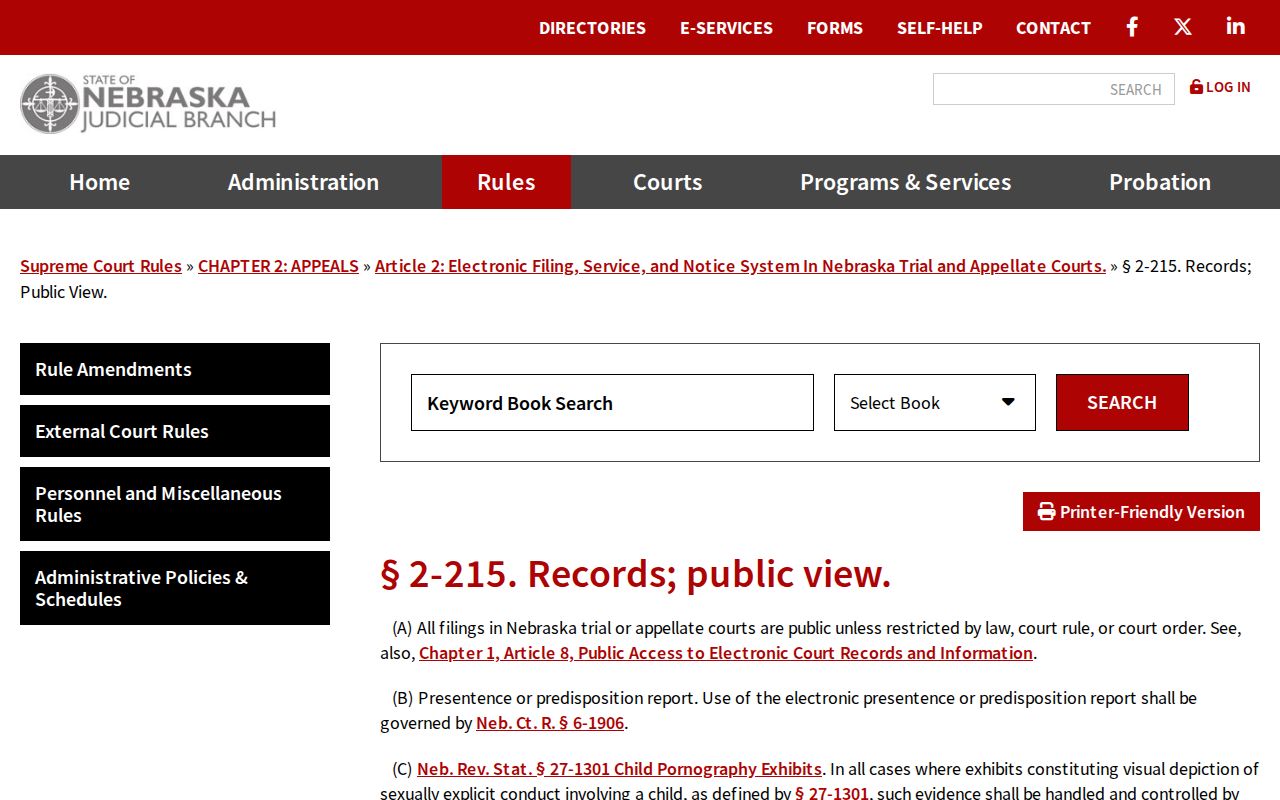
A Dixon County criminal docket has one firm boundary. The electronic view only works for material that stays open to public inspection. Some filings sit outside that window. For anything official, a trip or a letter beats the screen.
Know your case number and say exactly which document you need. Ask the clerk for a certified or authenticated copy. When the record is not online, you still have choices: the free terminal at the courthouse, the right court counter, or a written request that names the case. Appellate matters run through SCCALES instead. Federal cases belong in the federal court's own docket system, not in a Dixon County criminal docket search. Nebraska's Court Records Search Policy backs these routes. It allows clerk searches for a specific record and, where it fits, a written request under Nebraska public-records law.